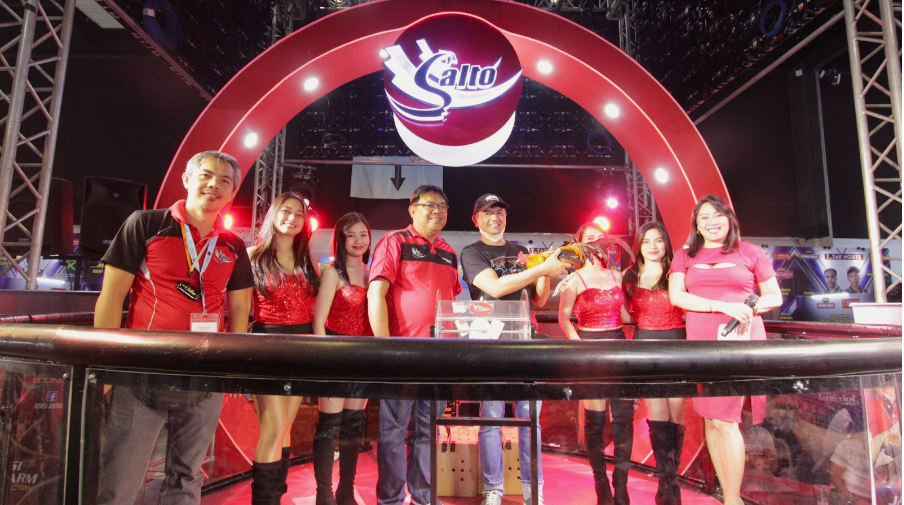
Salto, the gamefowl brand of Pilmico Animal Nutrition Corporation (Pilmico), showcases its brand’s excellence at the World Gamefowl Expo held last January 19 to 21, 2024, at the World Trade Center. During the expo, Salto demonstrated its commitment to producing high-quality gamefowl feeds through a wide array of activities for enthusiasts and industry professionals alike.
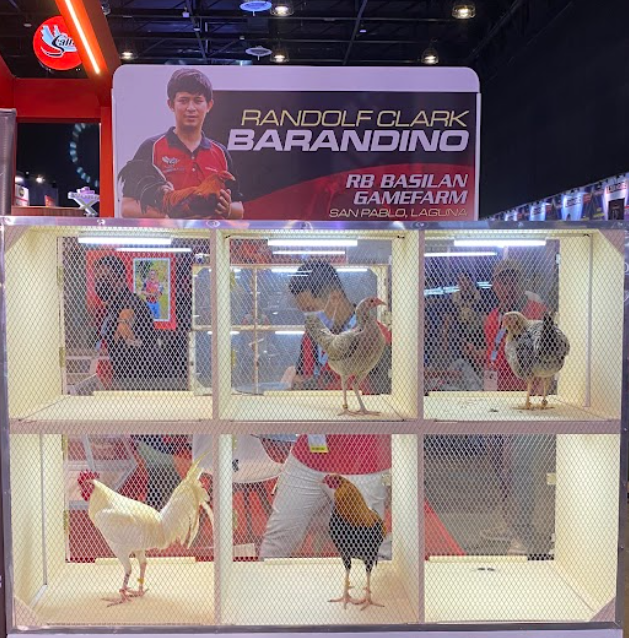
Salto endorsers brought their signature bloodlines, which were available for purchase.
The highlight of the event was the brand’s very own endorsers, known as ‘mga Alas ng Salto,’ who engaged with the attendees and shared their knowledge and expertise about gamefowl breeding. Additionally, attendees of the event also got the opportunity to purchase the signature bloodlines from Salto endorsers like Mike Decena, Randolf Barandino, Iskul Juan, Andrew Mendoza, Ching Obordo, Ericson Laurente, and Raymond Dayrit.
Swak ‘to sa Salto. Visitors of the booth who registered were able to play games at Salto’s booth and win exclusive merchandise.
Salto also hosted various exciting games, such as the famous pullet catching game, where 10 pullets were given away every day. They also held raffle draws that offered a “trio” prize consisting of two pullets and a breeder cock.
Catch Salto at the next event, International Gamefowl Fiesta, happening this February 9 to 11, 2024, at the SMX Convention Center Manila. Don’t miss the chance to participate in exciting games, win raffle prizes, and learn from gamefowl experts!
Frequently Asked Questions
1. What is this article about? This article reports on a gamefowl brand’s participation in the World Gamefowl Expo 2024, held January 19 to 21, 2024, at the World Trade Center in the Philippines. It covers the brand’s booth activities, the involvement of its endorsed breeders — collectively known as “mga Alas ng Salto” — live games with prizes, raffle draws, and the opportunity for attendees to purchase signature bloodlines directly from well-known gamefowl personalities.
2. Who are the “Alas ng Salto” and what did they do at the event? The Alas ng Salto are the brand’s official endorsers — veteran gamefowl breeders recognized for their expertise and champion bloodlines. At the expo, they engaged directly with attendees, sharing knowledge and best practices in gamefowl breeding. Several of them — including Mike Decena, Randolf Barandino, Iskul Juan, Andrew Mendoza, Ching Obordo, Ericson Laurente, and Raymond Dayrit — made their signature bloodlines available for purchase at the event.
3. What activities and prizes were available at the booth? The brand’s booth offered multiple interactive activities for visitors. A popular pullet catching game ran daily, with ten pullets given away each day to participants. Raffle draws offered a “trio” prize package consisting of two pullets and a breeder cock — a significant reward for serious gamefowl enthusiasts. Visitors who registered at the booth also had the opportunity to play games and win exclusive branded merchandise, creating an engaging and rewarding event experience.
4. What does the brand’s expo participation reveal about its industry positioning? Participation in the World Gamefowl Expo — the Philippines’ premier gathering for breeders and gamefowl industry professionals — signals serious market engagement beyond just feed sales. By bringing endorsers, live bloodlines for purchase, interactive games, and educational interactions under one roof, the brand positioned itself as an active stakeholder in the gamefowl community rather than simply a product supplier. This approach reinforces credibility and builds direct relationships with its core customer base.
5. What are the key takeaways from this event coverage? Three themes emerge from this article. Community engagement is central to the brand’s strategy — showing up at major industry events, not just selling through distributors. The Alas ng Salto endorser program goes beyond endorsement deals, involving breeders as active knowledge-sharing ambassadors. And the combination of education, entertainment, and live product availability — bloodlines purchasable on-site — demonstrates a holistic approach to building breeder loyalty that extends well beyond the product itself.
Life is slowly going back to normal, and the Philippines is rising again as we are starting to see encouraging signs of progress. While the whole country is not out of the woods yet, the collective Filipino effort is showing a positive impact on recovery not only on the economic aspects but also on the quality of life for everyone.
Some of us might appear more optimistic than others, and I was one of those who chose to see the positive side of things. We can all agree that, despite a decline of such an unprecedented scale, humanity will still have the resilience and find the strength to recover. That’s what makes us who we are.
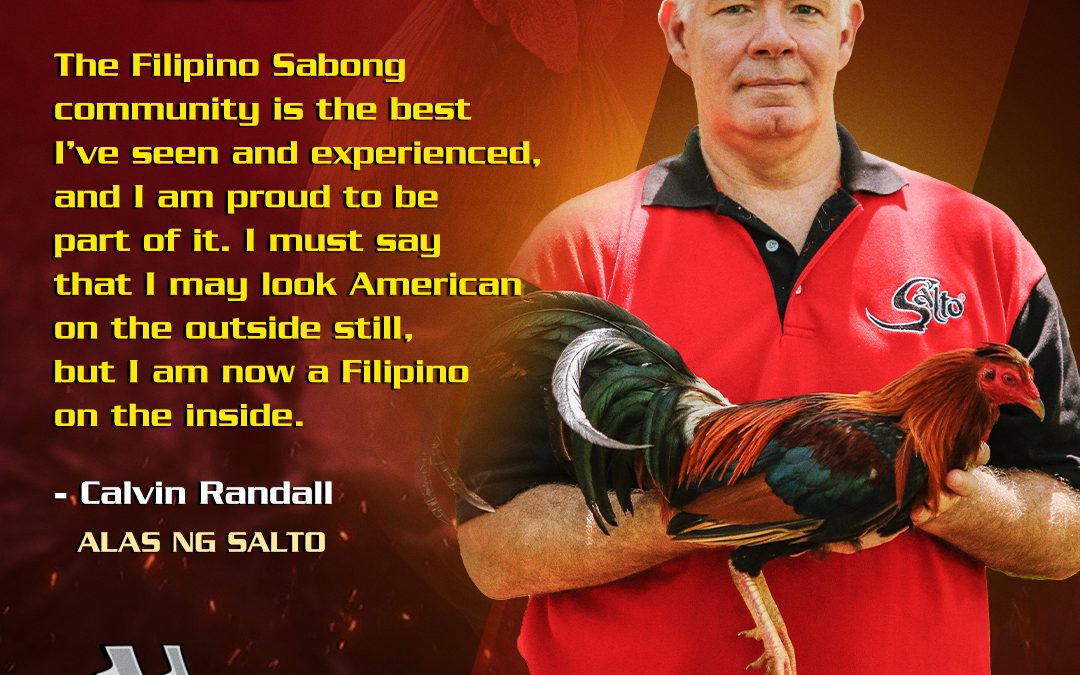
It may seem like a distant long ago, but I still clearly remember the day I landed in Manila. My heart was full of anticipation and positive thoughts for the future. I could have chosen another country to spend my retirement years in, but my heart chose the Philippines. The beauty of the Philippines is known worldwide, but even in its nooks and crannies, the country has many wonderful things to offer. Here I found my awesome Barkadas, built a family, and was allowed to live my dream– to run my very own farm and play Sabong as often as I could. The Filipino Sabong community is the best I’ve seen and experienced, and I am proud to be part of it. I learned more about the value of friendship and the importance of connecting with people; not only those who are your allies but even those who are your adversaries. I must say that I may look American on the outside still, but I am now a Filipino on the inside.
I often say I am a Sabungero through and through, not because I’m a gambler but because I am a breeder at heart. I hate to be called a braggart, but I believe I am good at my craft. It’s the personal touch that makes a lot of difference. What I love about Sabong is the friendship that comes with it. It’s the noise I hear when I enter the Arena, the excitement of the spectators, the pounding of the elevated heart rate that I feel while preparing my entries, the shaking of hands, the vendors selling peanuts and drinks, the friends celebrating with you in your victories and, the warm and friendly handshakes exchanged with your competitors. It’s the human interaction that I sorely miss. And today, I asked myself, what is the future of this sport that I love so much?
Will we ever go back to how we were before the COVID-19 pandemic wreaked havoc on our lives?
The truth is, our world could change in many ways beyond our imagination. The human condition has been dramatically altered due to the policies enacted for our protection. The safety measures have diminished our ability to connect in the physical sense, but they are not necessarily less meaningful.
Everyone is becoming more comfortable with virtual communication, and Sabong has been greatly affected by these changes. What is the future of our sport? The future is unknown, but we’ll cross the bridge when we get there.
What is the future of Sabong? Who will inherit the sport? Who will keep it alive? How will our generation work it out?
If what we witnessed in the past few years is even a slight indication of how strong and resilient the Filipino spirit is, then I am excited to enjoy the ride and watch this next chapter unfold.
If the strong Filipino spirit of rising through the ashes is alive, now that is something I’m willing to watch unravel.
Frequently Asked Questions
1. What is this article about? This is a first-person reflective essay written from the perspective of Calvin Randall, an American-born gamefowl breeder who chose the Philippines as his home. Written in the wake of the COVID-19 pandemic’s disruption to traditional cockfighting, the piece reflects on what sabong means at a human and cultural level, what was lost during the pandemic-enforced suspension of in-person events, and what the future of the sport might look like as the country recovers.
2. Who is Calvin Randall and what is his connection to Philippine sabong? Calvin Randall is a foreign-born breeder who relocated to the Philippines and built his life around the local gamefowl community. He describes himself as a sabungero — a cockfighting enthusiast — not primarily as a gambler but as a breeder by passion and identity. Over time he formed deep friendships within the community, built his own farm, and came to identify strongly with Filipino culture, describing himself as Filipino on the inside despite his American appearance.
3. What aspects of traditional sabong does the author say he misses most? The author focuses entirely on the human and social dimension of the sport rather than the competition itself. He describes missing the noise and energy of the arena, the excitement of spectators, the handshakes exchanged with competitors, vendors in the crowd, friends celebrating victories together, and the physical presence of people sharing an experience. For him, it is the human interaction — the friction, fellowship, and ritual of in-person sabong — that the pandemic stripped away and cannot be replicated virtually.
4. How does the author view the impact of the pandemic on sabong? The pandemic is portrayed as a force that fundamentally altered the human condition surrounding the sport. Safety measures required to protect public health diminished the physical connectivity that gives sabong its cultural meaning. The author acknowledges that virtual communication has grown more comfortable for everyone, but treats this shift as a change to navigate rather than a permanent replacement for what traditional, in-arena sabong provides to its community of breeders, bettors, and spectators.
5. What are the key takeaways from this piece? Three ideas emerge as central. Sabong, for its most dedicated practitioners, is primarily about community and human connection rather than gambling or competition alone. The pandemic forced a reckoning with how deeply physical presence matters to a tradition built on face-to-face ritual. And the Filipino spirit of resilience — the author’s phrase is “rising through the ashes” — is held up as the foundation for confidence that the sport and its culture will survive, adapt, and endure through whatever form the future brings.
We use cookies to ensure you get the best experience while browsing our site. By continued use, you agree to our privacy statement and accept our use of such cookies.OKPrivacy Statement


Recent Comments